FINTECH
AI STRATEGY
PRODUCT DESIGN
Turning Hidden
Leaks into
Recovered Revenue
Redesigning how finance teams find and fix silent revenue leaks
trending_up
+3.5x
weekly active LEARNERS,
12 WEEKS POST LAUNCH
trending_up
+72%
higher ai adoption,
across finance teams
trending_up
+85%
faster reconciliation,
per audit average
Summary
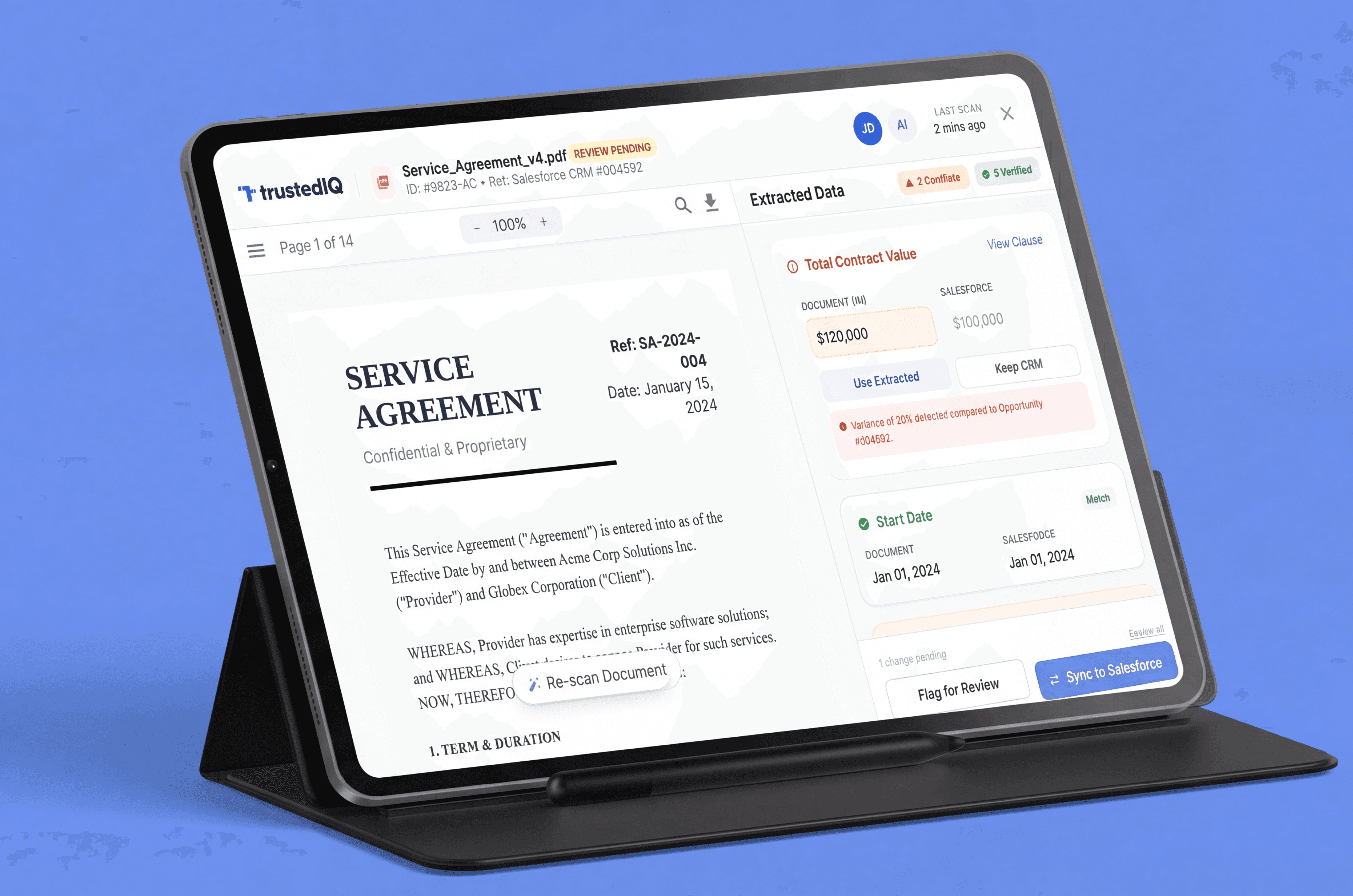
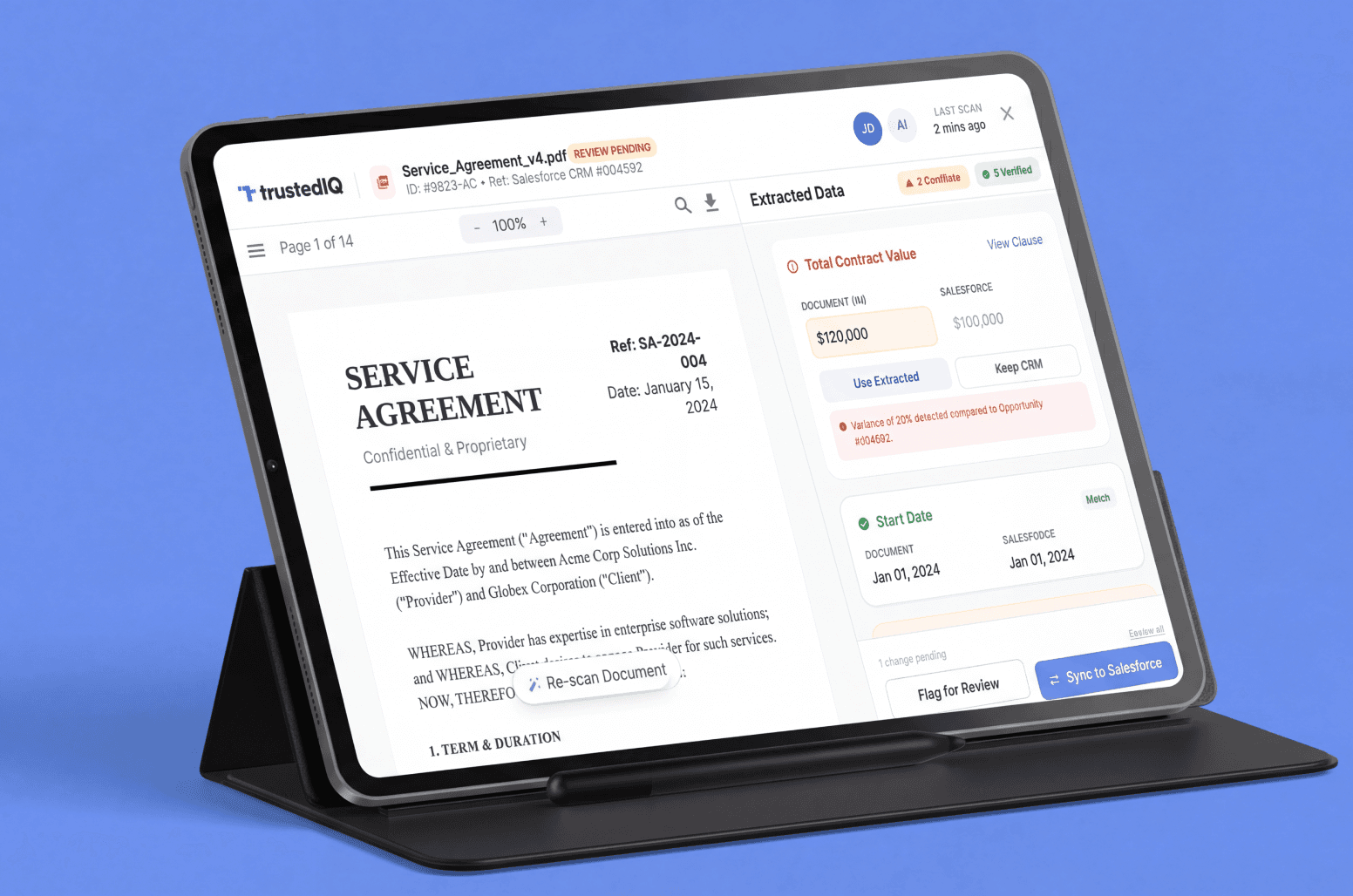
TrustedIQ is an AI-powered platform for Finance and RevOps teams. It audits CRM records against signed contracts to surface silent revenue leaks like mismatched billing terms, incorrect dates, wrong values, that quietly erode contract value.
The platform had the data. It had the AI. But the interface was burying both. Finance teams were spending hours on manual row-by-row auditing instead of focusing on the discrepancies that actually cost money.
I was the sole product designer, working alongside one engineer and the founding team. I owned research, UX strategy, interface design, and testing. My job was to turn a powerful but clunky audit tool into something finance teams would actually want to open every morning.
$42.5M Was at Risk, And Nobody Could See It
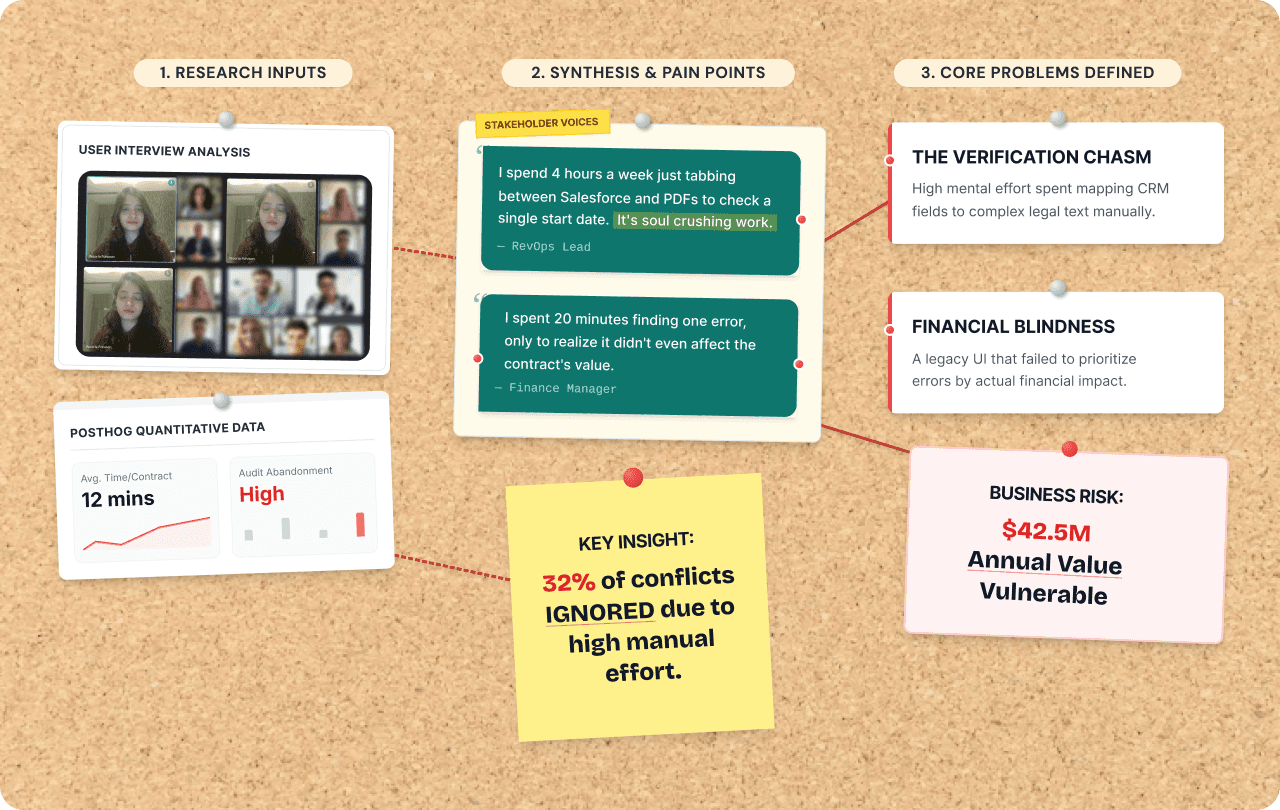
TrustedIQ sat on a goldmine of data, but its value was buried under a flat, unprioritized interface. Leadership saw fragments instead of the full picture. Finance teams saw hundreds of flagged errors with no way to distinguish a $50 zip code mismatch from a $10,000 billing discrepancy.
The result: 32% of data conflicts were simply ignored. Not because teams didn't care, because the interface gave them no reason to care about one row over another. Every error looked the same.
I stepped in to shift the product's narrative from "fixing errors" to actively protecting revenue.
PROBLEM DISCOVERY
Where Revenue Was Falling Through the Cracks
I mapped user workflows, session data, and stakeholder interviews to identify three core friction patterns, each one preventing the platform from delivering the value it was built to provide.
psychology
Context Switching Was Killing Accuracy
"I'd find a number in the CRM, switch to the PDF, and by the time I found it, I'd forgotten what I was checking."
observation
Verifying a single contract took an average of 12 minutes. Users had to hold a value in short-term memory; a start date, a billing term while tabbing between the CRM view and a 14-page legal document. The mental load was unsustainable.
root cause
The verification workflow was split across multiple screens with no shared context. Every tab switch forced the brain to reload, creating fatigue and a high abandonment rate on complex contracts.
design pivot
Unified split-view that places CRM data and contract documents side by side
analytics
Flat Lists Hide High-Impact Risks
"I'd click through rows for an hour before realizing none of them mattered."
observation
The platform presented hundreds of "Field Errors" in a flat list with no sense of priority. Users were manually clicking through every row regardless of deal size, a $1M partnership carried the same visual weight as a $1,000 renewal.
root cause
The system weighted a zip code mismatch the same as a $10,000 billing error. Users spent 80% of their time on low-value tasks because the interface couldn't tell them what mattered.
design pivot
Impact-ranked dashboard with urgent action modules and financial risk badges.
psychology
Executives Couldn't See the Pipeline
"I don't need to know the status of every billing contact. I need to know if we're leaking money."
observation
Executive users were avoiding the platform entirely. They didn't want row-level audit data, they wanted to know the health of the revenue pipeline at a glance. The platform was built for analysts, not decision-makers.
root cause
The interface was cluttered with technical metadata that served the audit process but obscured the financial story. The value of a dashboard is determined by how quickly it leads to a decision — and this one led nowhere fast.
design pivot
Executive oversight layer with AI insights and pipeline health at a glance.
USER FLOW TRANSFORMATION
From Manual Auditing to Impact-Led Resolution
The old flow treated every error equally. Users scanned flat lists, tabbed between screens, and gave up before reaching what mattered. I restructured the flow around financial impact: highest-risk discrepancies surface first, resolution happens in a single split-view pane.
My first iteration ranked by dollar amount alone. Testing revealed timing mattered too, a $5,000 error renewing next week beats a $50,000 error renewing in six months. That added a time-urgency layer to the ranking.

Impact Analysis
Metric
Legacy Flow
New Flow
User Intent
Finding Errors in a Sea of Data
Resolving Financial Risks
Discovery
Manual: Hunting through tabs
Automated: AI-driven
alerts
Friction
High: Field-by-field manual entry
Low: Bulk 'Auto-Resolve'
User Role
Manual Auditor
Strategic Decision-Maker
Outcome
Clean Data
Recovered Revenue
Key Insights
Legacy Pain Point
Users had to navigate:
All Deals → Specific Deal → Checklist Tab → Individual Field to find a single error.
Transformed Solution
The Conflict Resolution Hub bubbles up every
discrepancy across the entire organization into one list, sorted by "Highest Impact".
Design Impact
Single-pane resolution enables instant underbilling recovery, transforming manual maintenance into strategic revenue protection.
psychology
The Insight
Dual-CTA modals caused cognitive paralysis, leading to a 31% bounce rate as students struggled to choose a path.
STRATEGIC WORKFLOW PIVOT
Reconciliation,
Rebuilt
psychology
The Problem
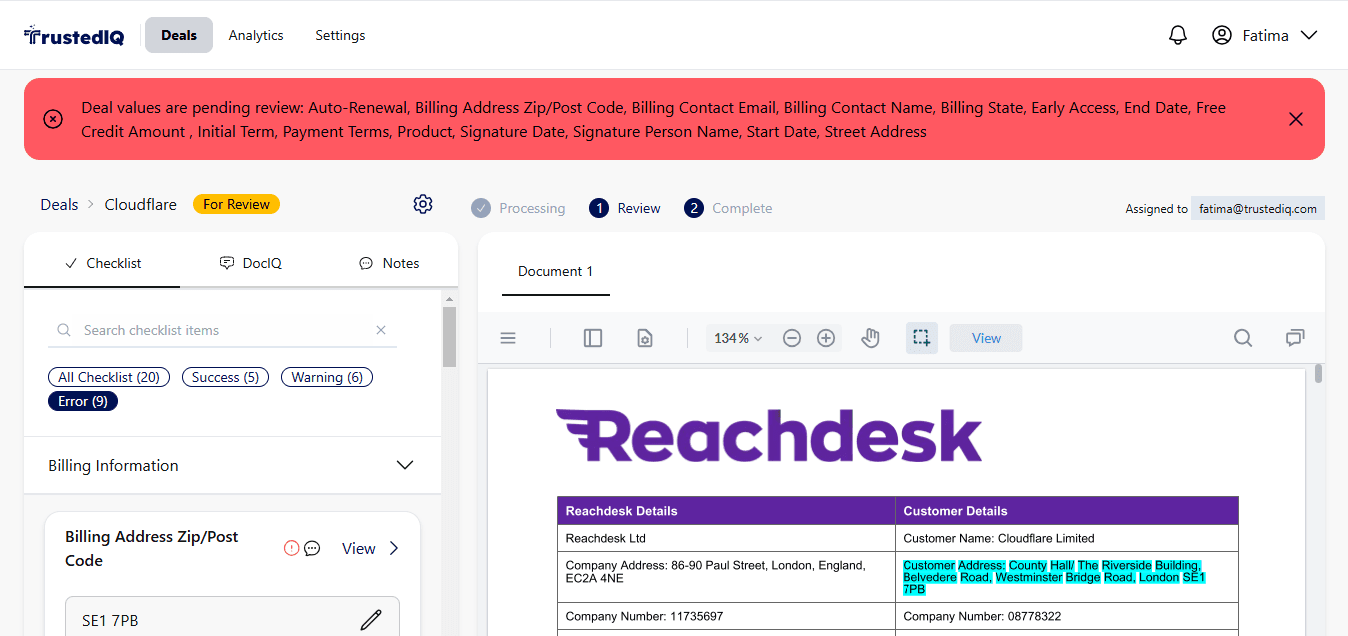
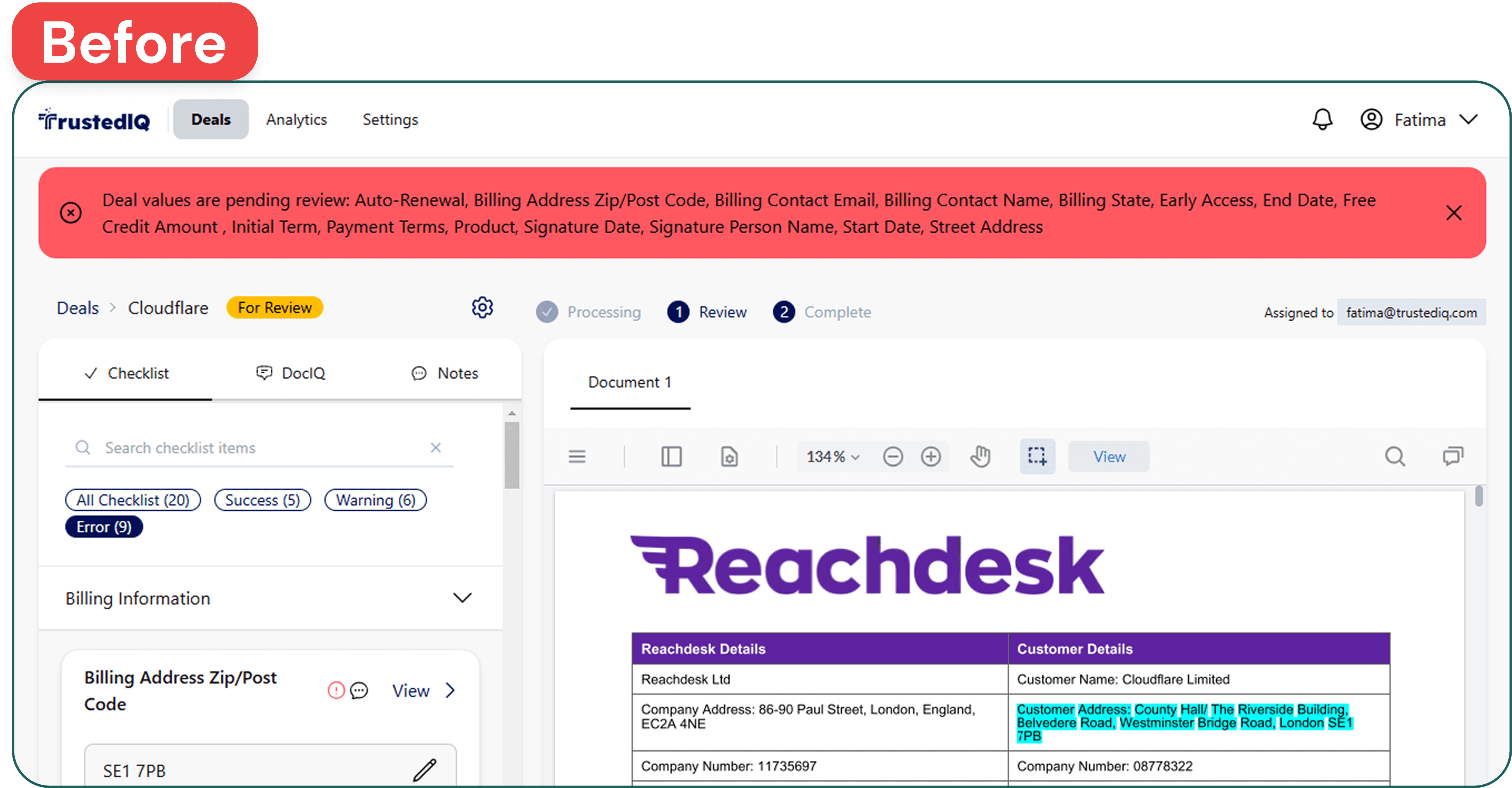
The legacy flow was built for verification, not velocity. Red error banners and manual "Save Value" buttons created a high friction environment where users spent hours correcting trivial data points.
alt_route
The Pivot
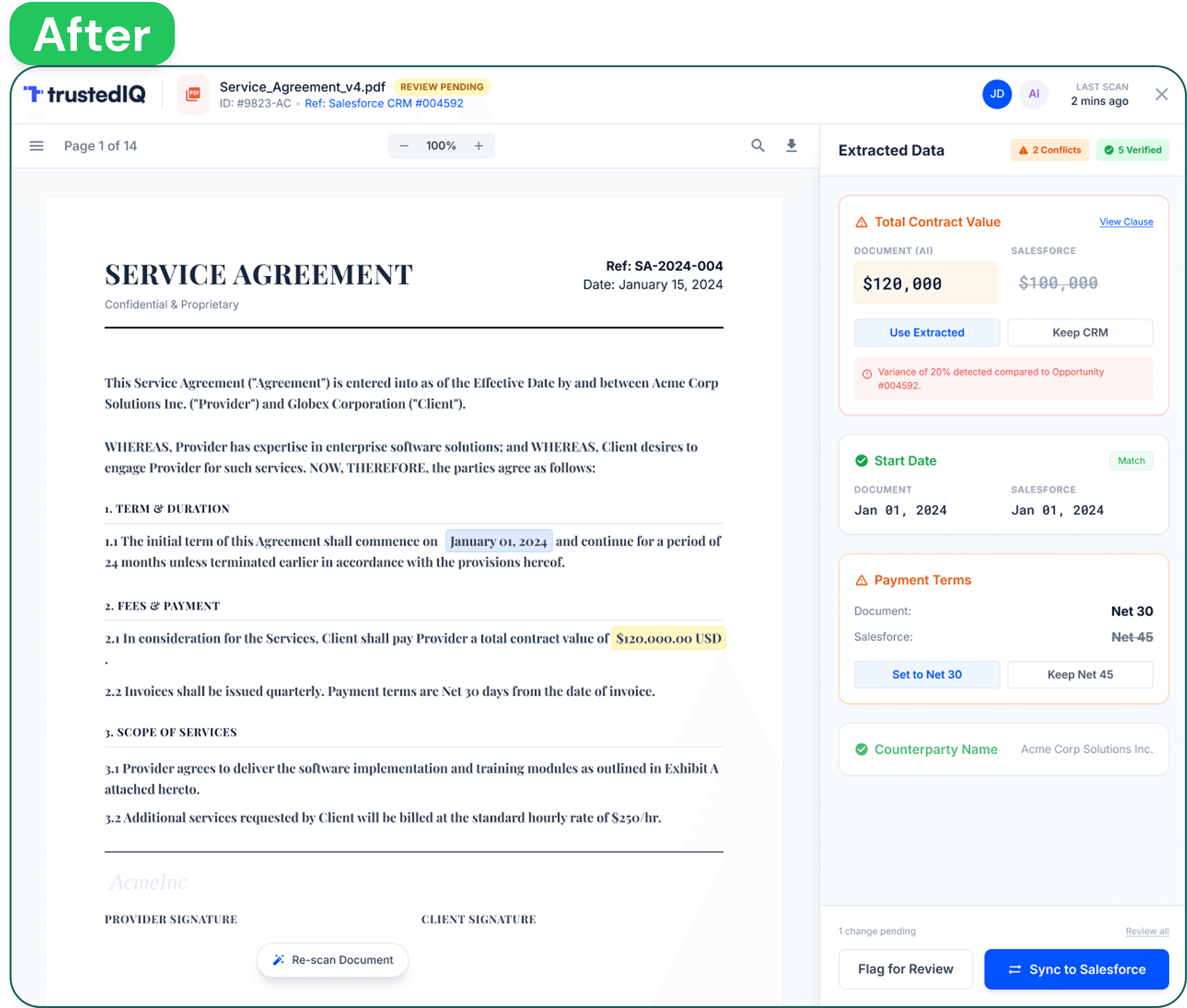
We redesigned the flow to prioritize Impact Analysis. By surfacing the most significant financial discrepancies first, we collapsed a multi-step search process into a single-pane resolution hub.
verified
The ROI
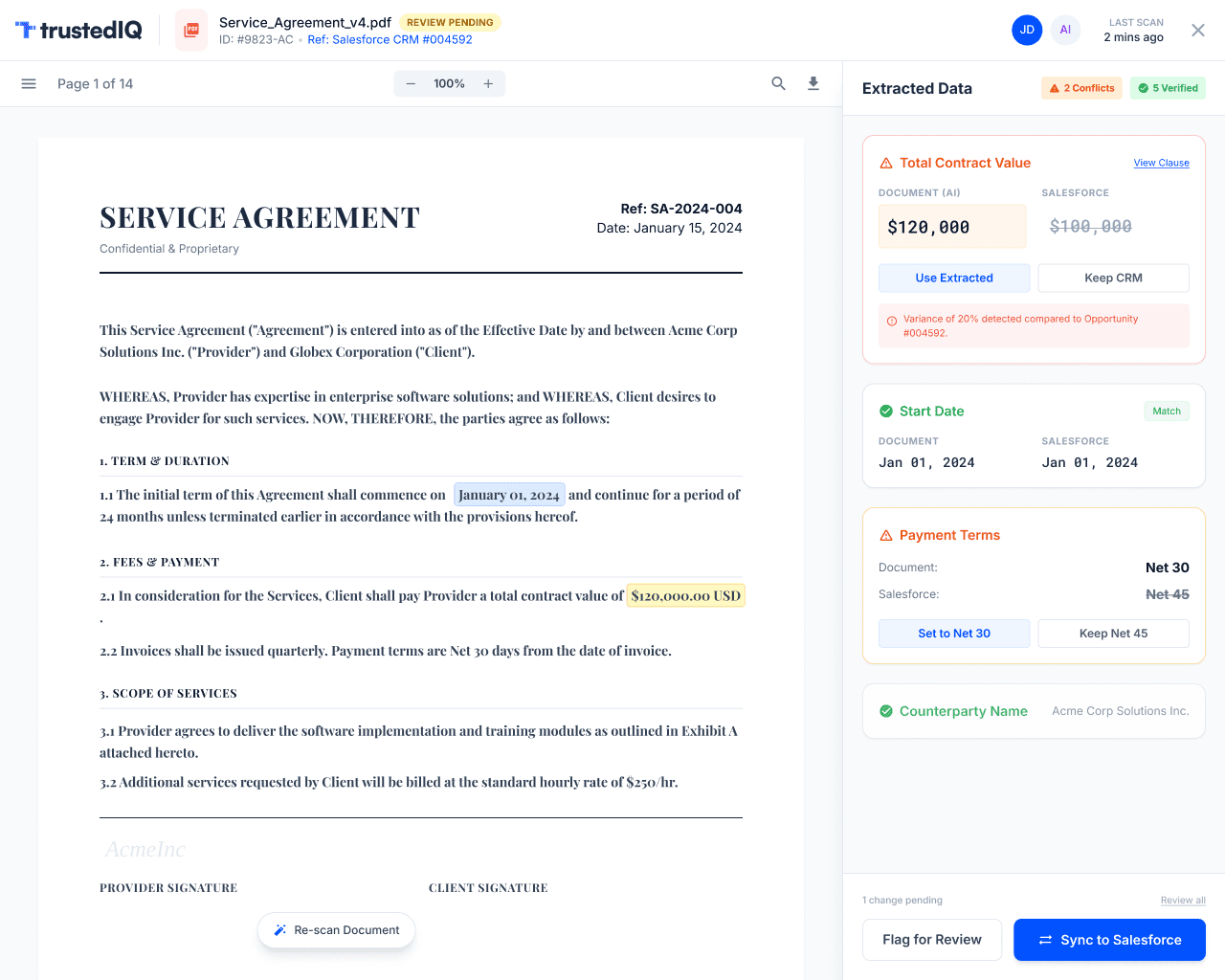
What took 12 minutes across multiple tabs now takes under 2 in one view. Document values on the left, CRM on the right, conflicts flagged in real time, one-click sync to Salesforce. No context switching.
check_circle
Conflict at a Glance
Document and CRM values side by side. Discrepancies flagged instantly, no hunting, no memory.
check_circle
Resolve Without Leaving
One-click resolution inline. Users fix mismatches where they find them instead of switching tabs to save.
close
Wall of Pending Fields
20+ fields dumped into a single banner. Users had to mentally sort which ones actually mattered.
close
Split Attention, No Connection
Checklist values on one side, contract text on the other, with no visual link between matching fields.
dashboard overhaul
From Deal List to Command Center
psychology
The Insight: Drowning in Rows
Passive Audit Log: Forced manual, row-by-row scanning just to gauge basic work status.
Zero Visual Hierarchy: Every deal carried the same visual weight, regardless of whether it was a $1,000 renewal or a $1M partnership, masking high-impact deals.
Invisible Risk Exposure: Critical contract values and financial risks were buried inside records, hidden from leadership.
High Administrative Noise: Irrelevant fields like "Billing Contact" distracted users from the core mission of revenue protection.
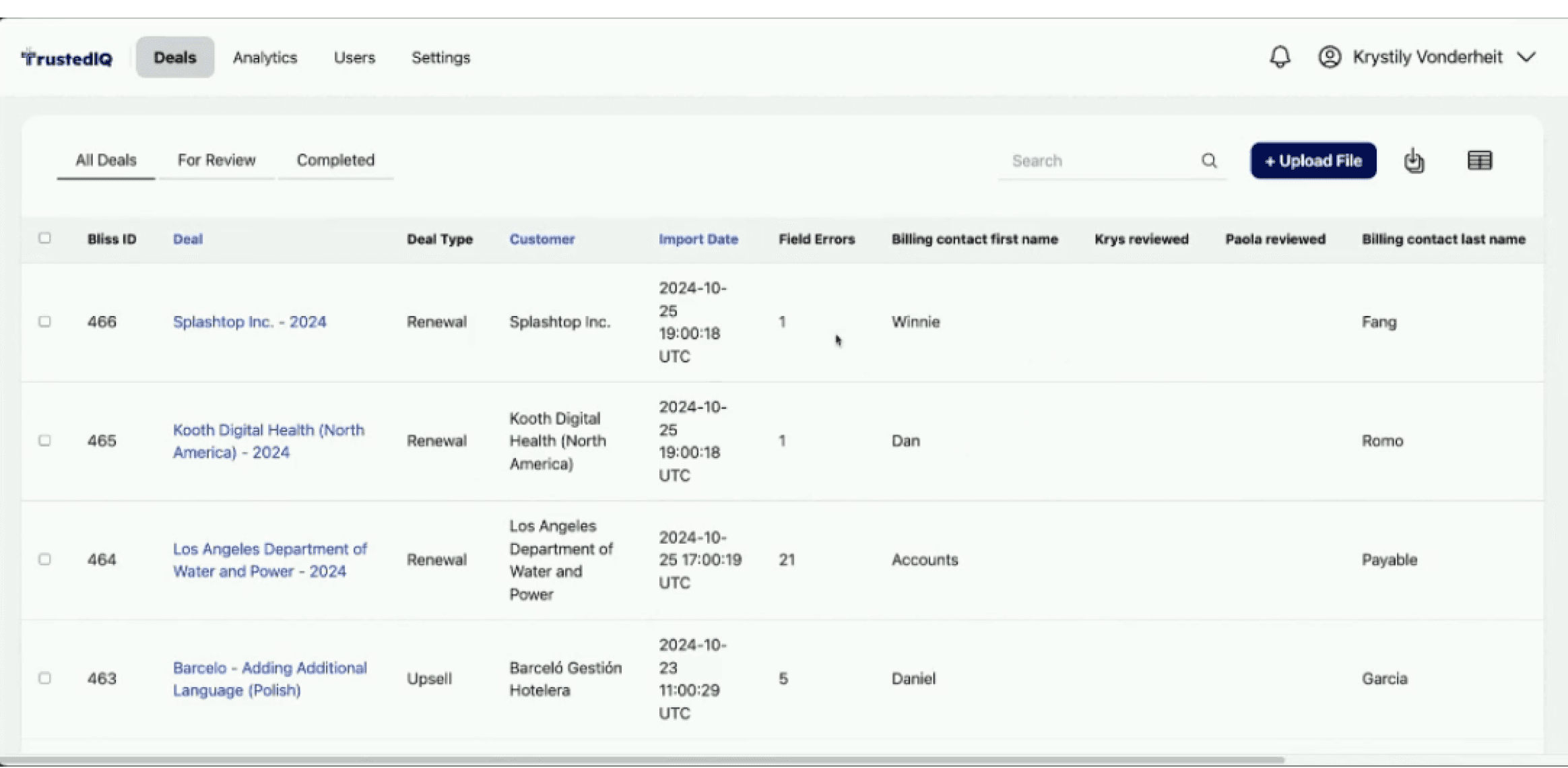
Before
alt_route
The Pivot
High-Level Hero Metrics: I introduced cards for "Total Contract Value" ($42.5M) and "Pipeline Health" to give executives an instant pulse on the business.
The "Urgent Action" Nudge: I added a high-contrast orange card that serves as a focal point, telling the user exactly how many contracts (e.g., 8 Contracts) need immediate review.
Strategic Table Design: I stripped away the administrative clutter and replaced it with high-signal data: Status Tags (Urgent, Review, Active), Data Source (Salesforce, NetSuite), and Contract Value.
Topic A
Topic B
Topic C
Topic D
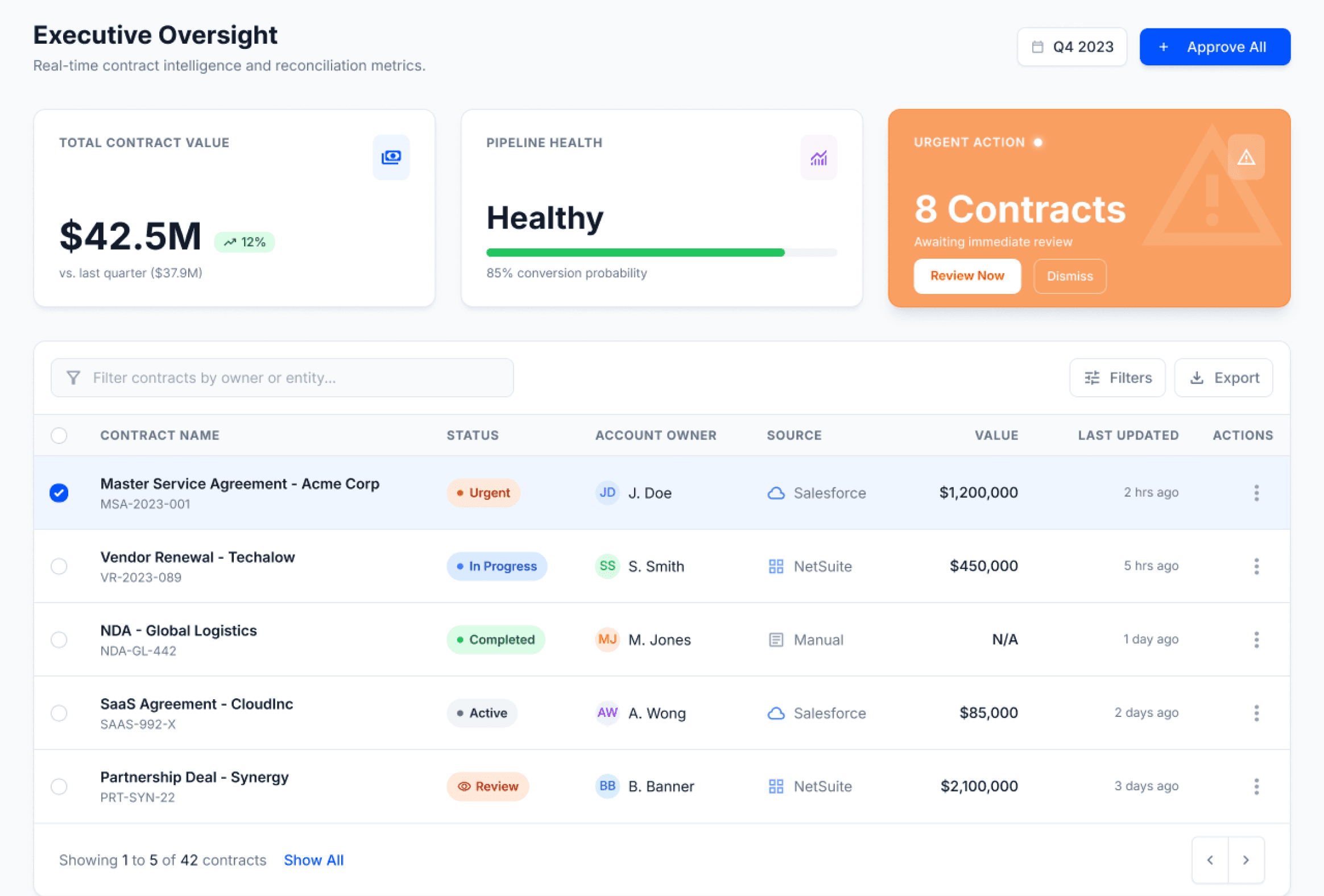
After
the roi
Speed to Decision
Executives no longer hunt for discrepancies; they open the dashboard and immediately see a prioritized list of revenue risks, allowing for faster, higher-confidence approvals.
ai integration strategy
AI as a Business Partner:
From Passive Tool to Active Co-Pilot
This project was a masterclass in balancing user psychology with business goals. Here are the three core truths I uncovered while navigating the ‘Learning Labyrinth.’
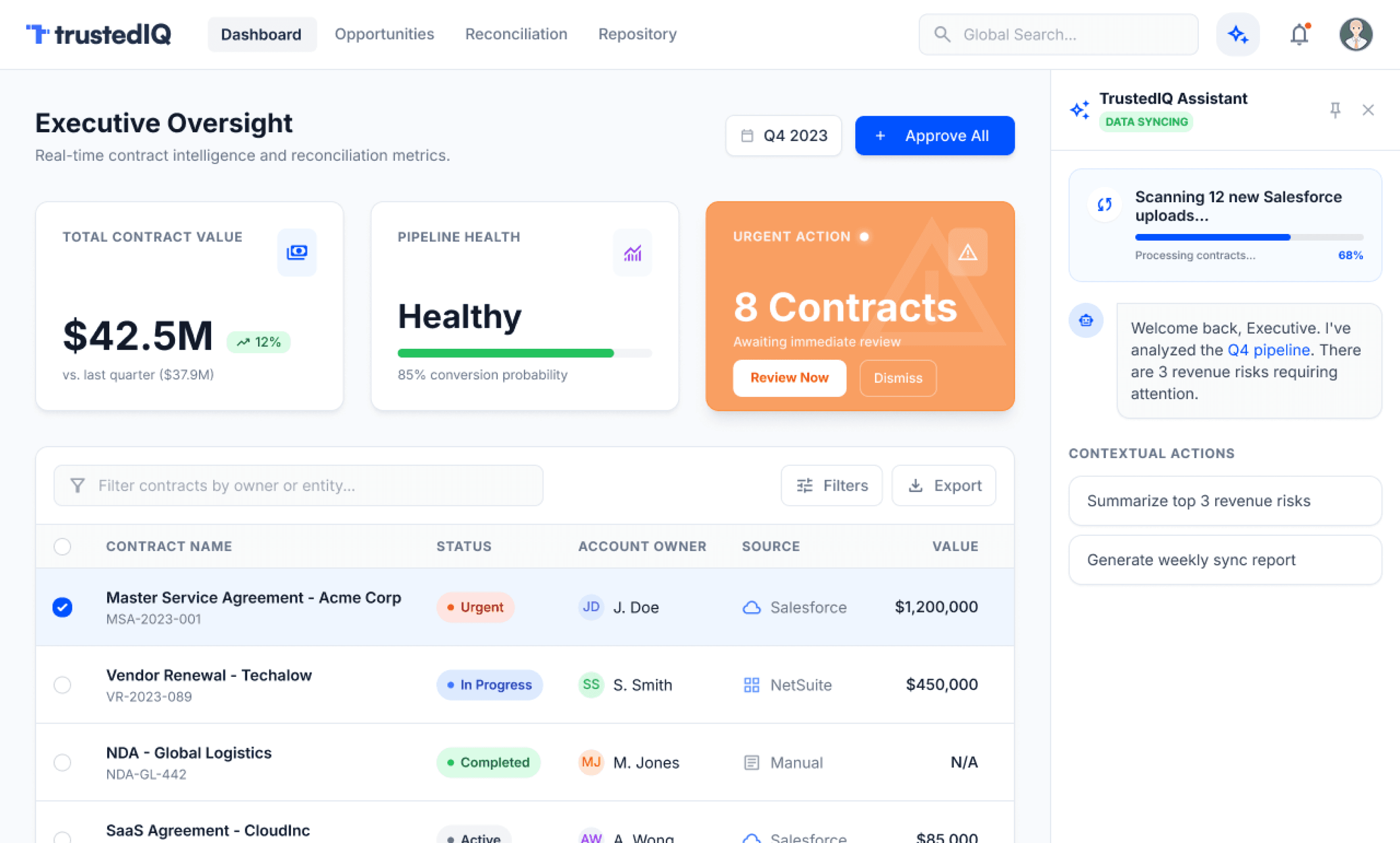
Contextual Intelligence
The sidebar doesn't just chat; it reads the active screen state to offer actions relevant to the specific data being viewed.
Proactive Processing
Instead of waiting for user input, the system runs in the background (scanning uploads), surfacing results only when actionable.
One-Click Resolution
Complex workflows like "Risk Summarization" are collapsed into single-tap "Contextual Action" buttons.
conflict resolution hub
Scaling Efficiency with Batch Auto-Resolve
When a user has 15+ detected discrepancies, they need a way to triage them based on Financial Gravity.
Impact-Based Sorting: I implemented filters for "Financial Impact," "Dates & Terms," and "Entity Data" so teams can prioritize the bottom line first.
One-Click Resolution: For high-confidence mismatches (e.g., "98% Confidence"), I added an "Auto-Resolve" button that can handle batch updates instantly, drastically reducing the manual workload.
The Profit Narrative: Every conflict card clearly displays the stakes, such as "+$5,000/mo Recovered Revenue" or "$12,500 Underbilling Risk".
Topic A
Topic B
Topic C
Topic D
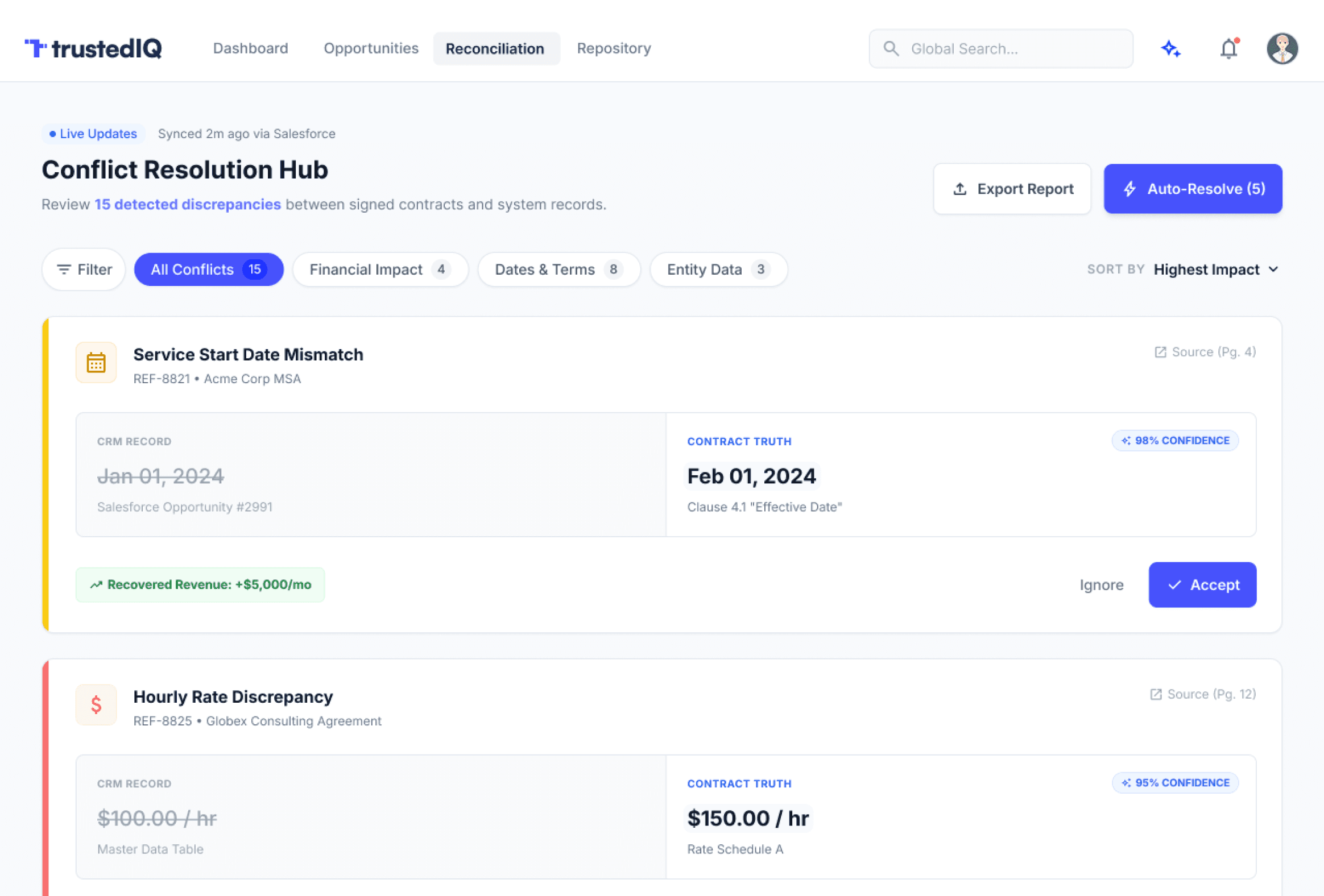
OPTIMIZED
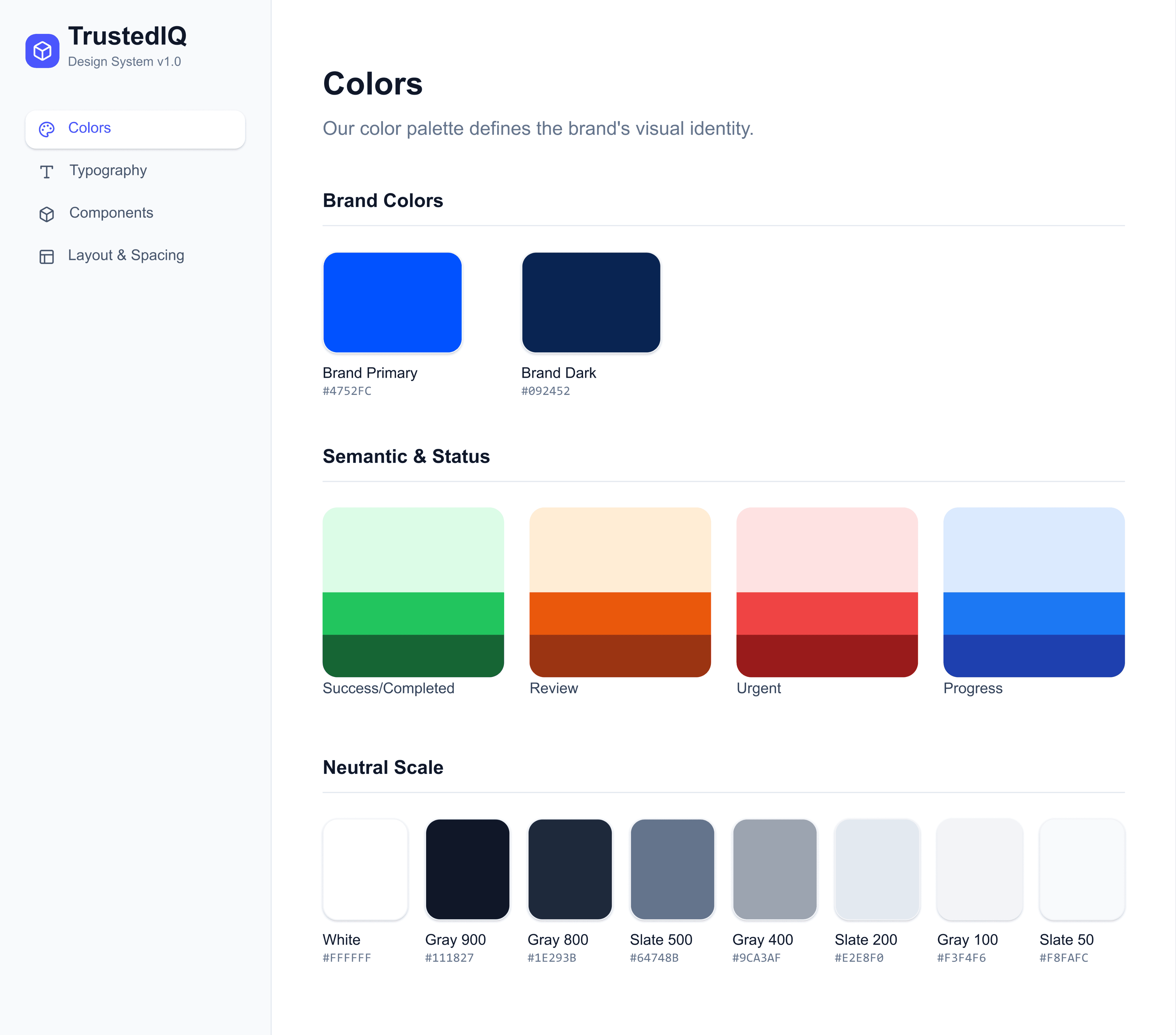
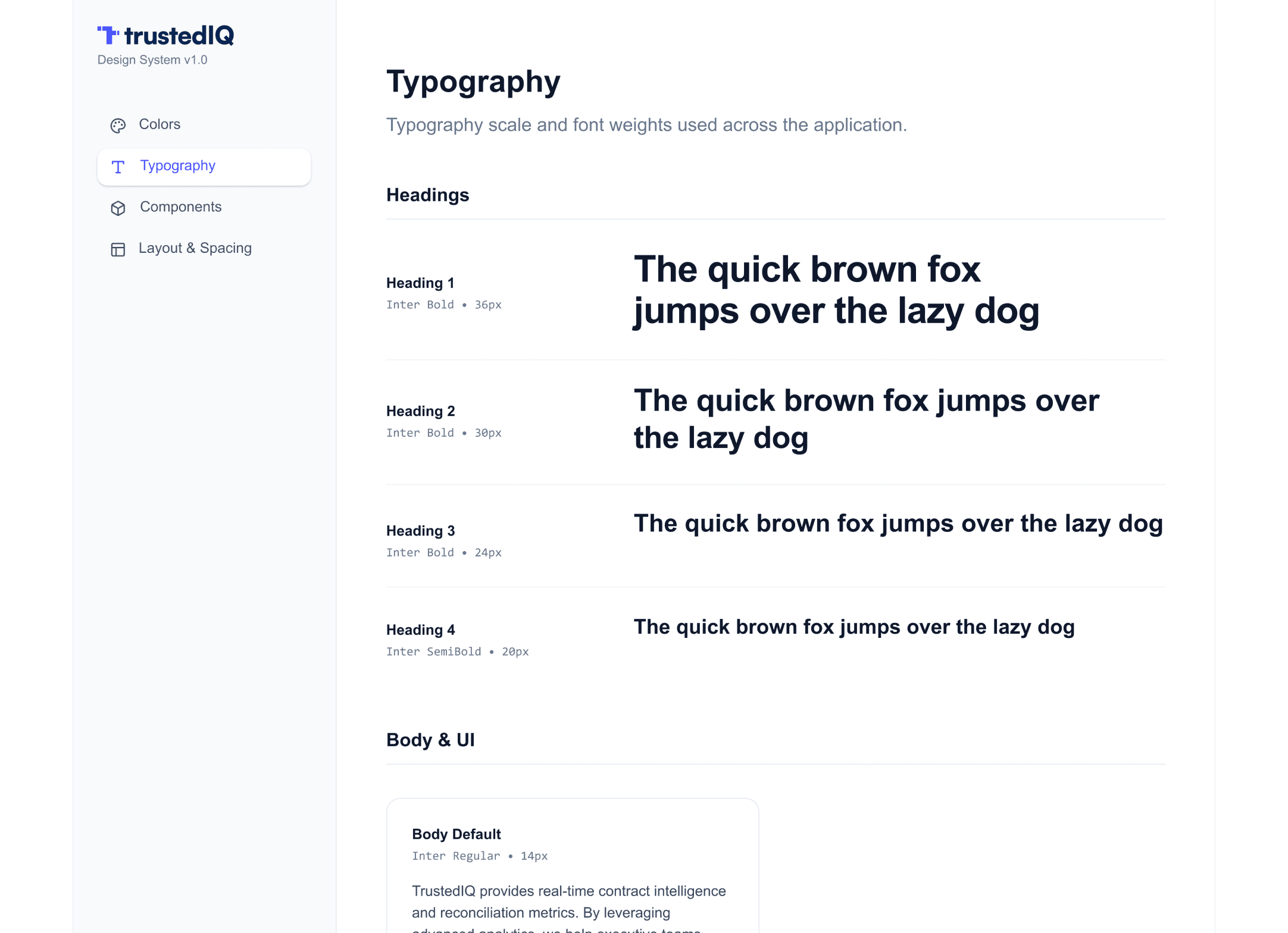
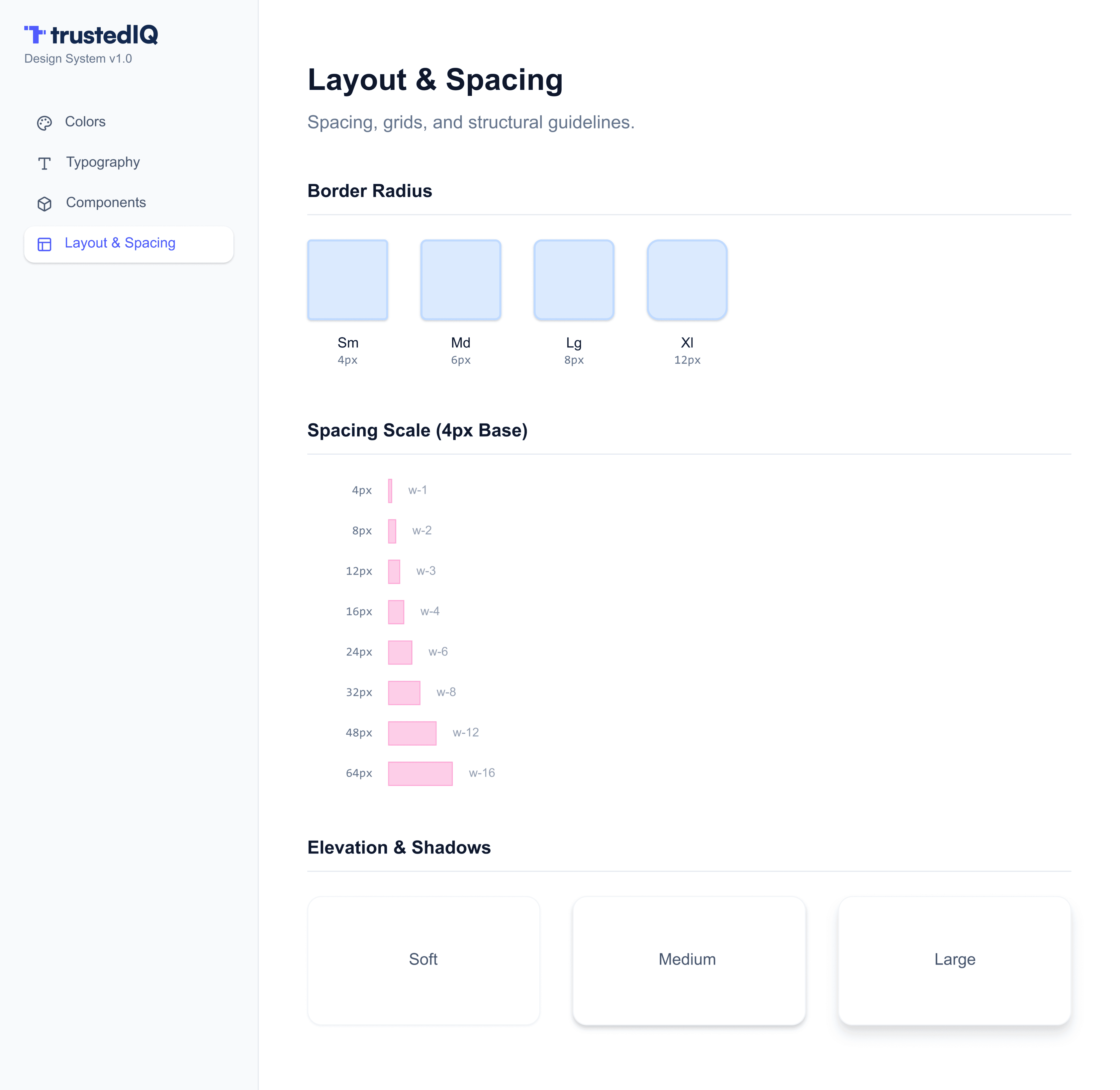
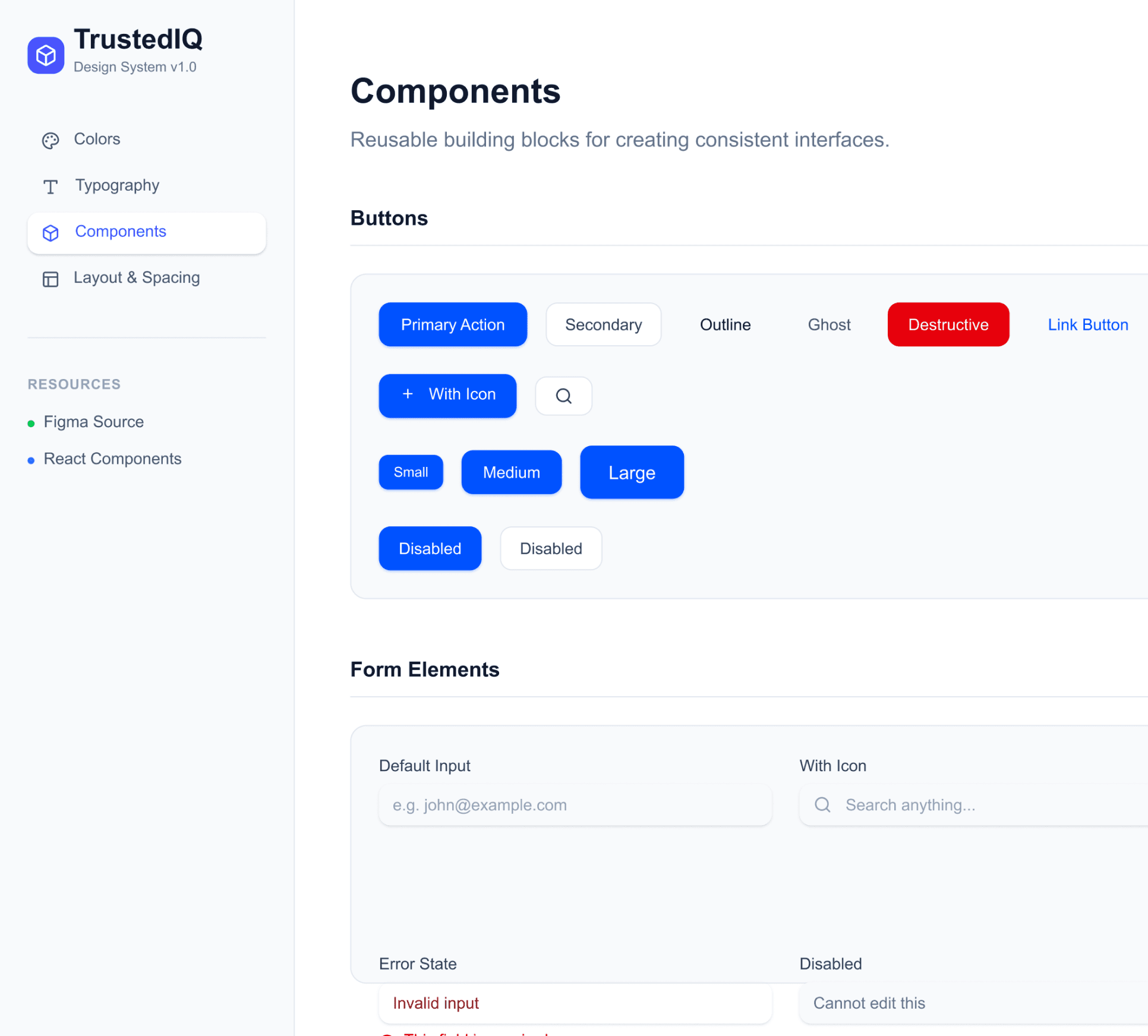
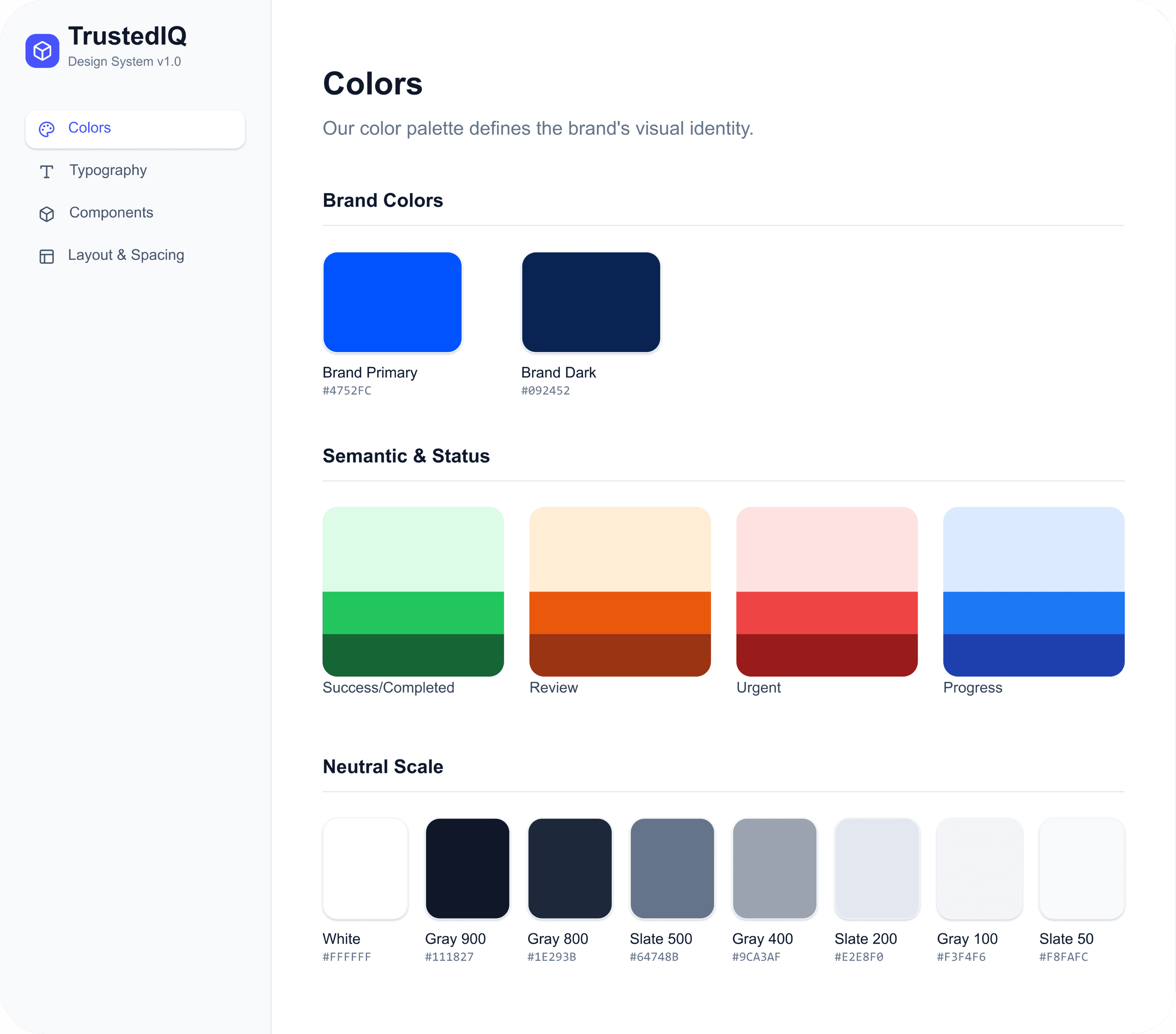
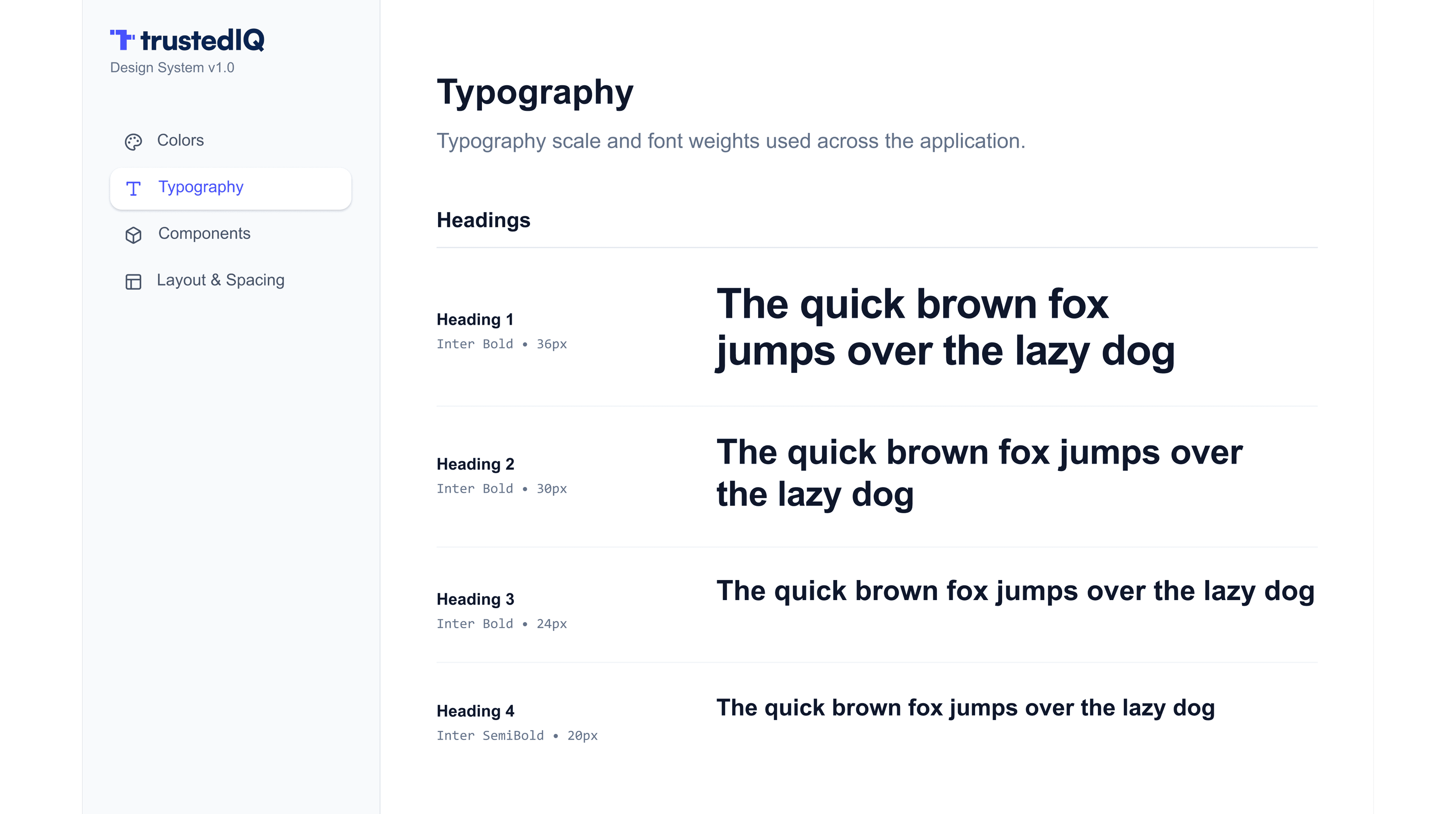
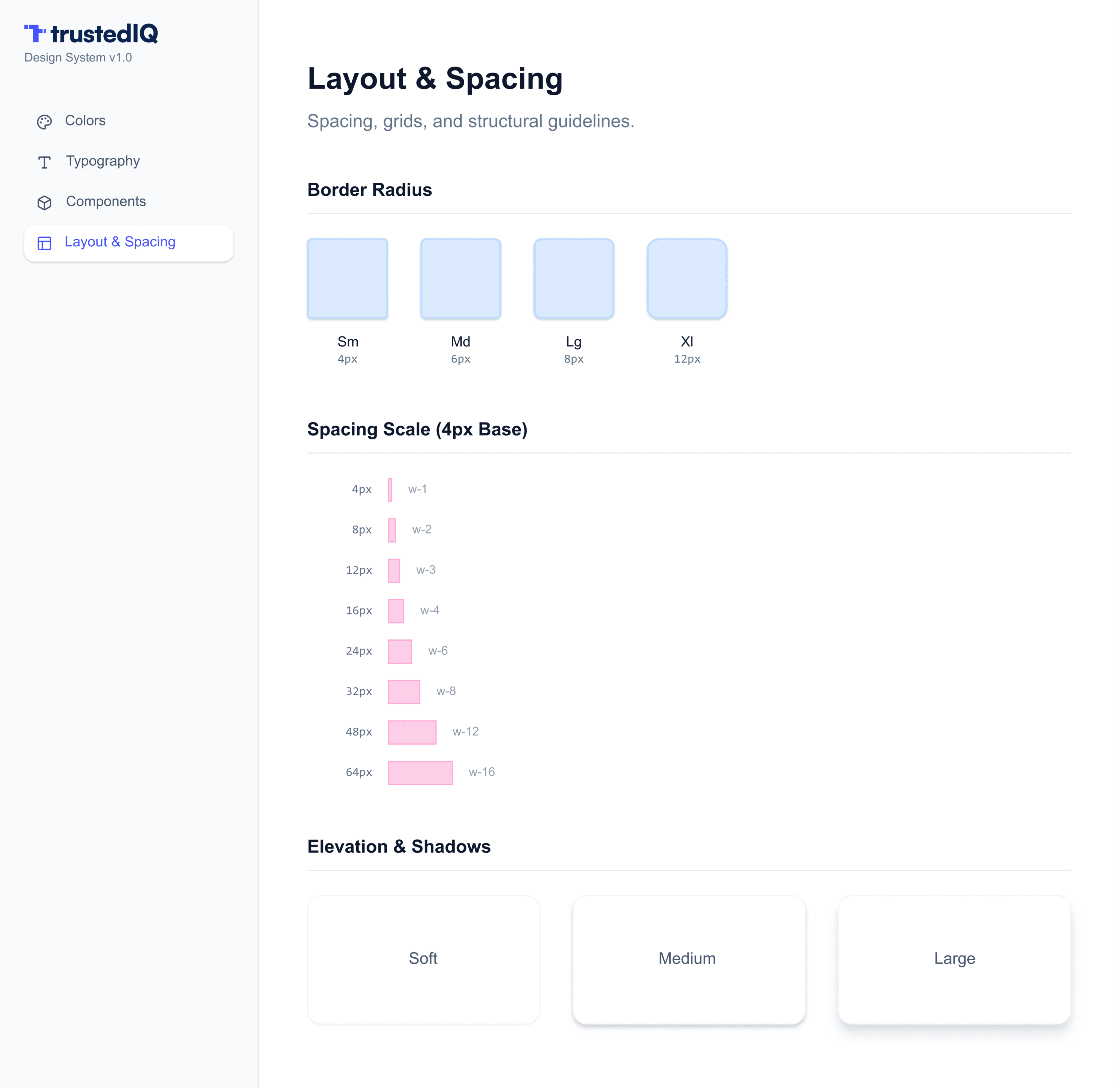
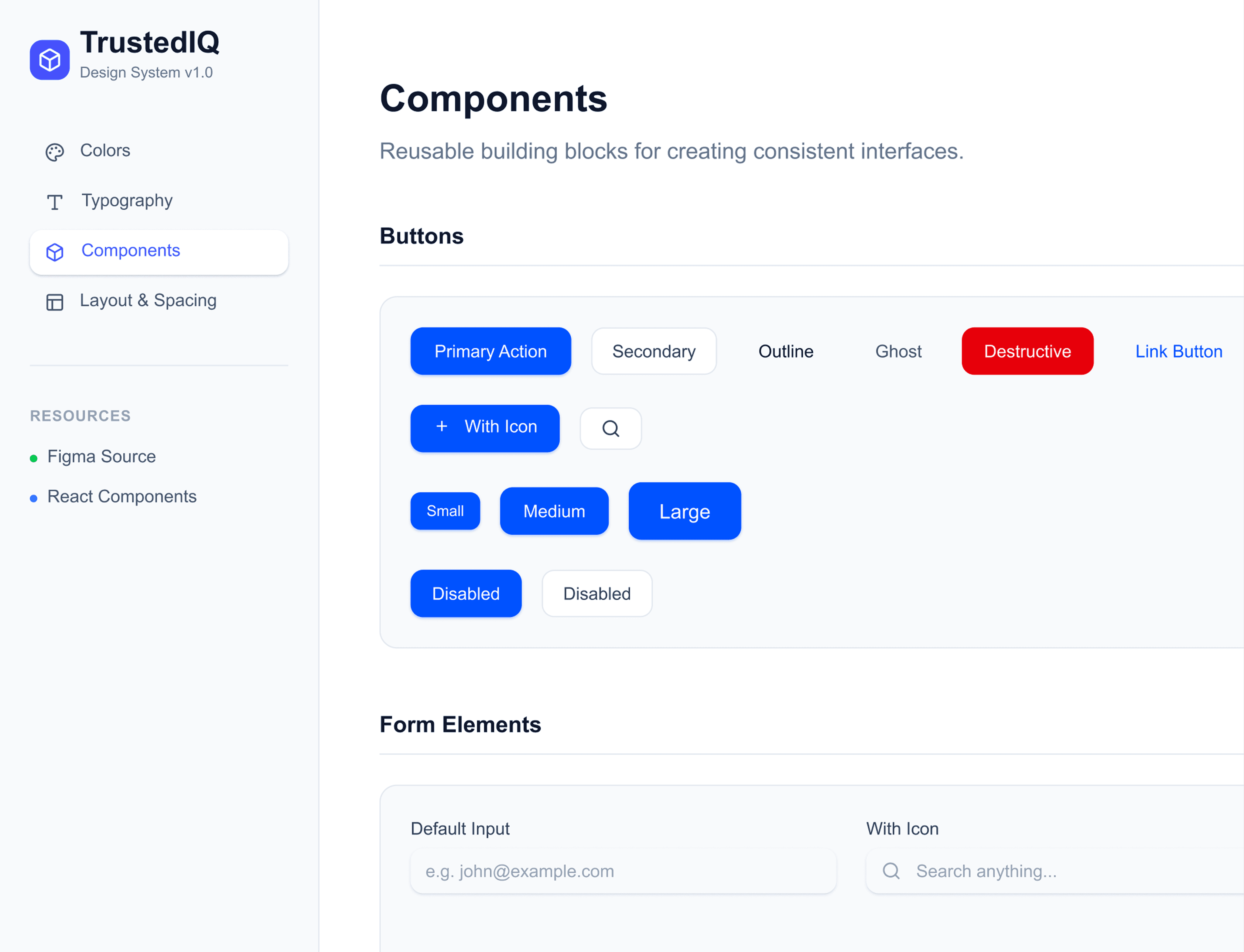
Cohesive Visual Language
Constructing Trust Through Design: Design Systems

the compound effect
3.5x
Weekly active users grew 3.5x, the compound result of faster reconciliation, smarter prioritization, and an interface that executives actually wanted to use.
the compound effect
3.5x
Weekly active users grew 3.5x, the compound result of faster reconciliation, smarter prioritization, and an interface that executives actually wanted to use.
a shift in logic
What This Project Taught Me
Three things I'd carry forward from designing for finance teams.
Data Density Isn't Data Value
The original dashboard had more information than the redesign. It was also less useful. I learned that in data-heavy products, the design challenge isn't showing everything, it's deciding what deserves attention and what deserves to disappear. Curation is the product.
Finance Teams Think in Risk, Not Records
I initially organized the interface around data accuracy, clean records, resolved errors, field mismatches. Users didn't care about clean data for its own sake.
They cared about what dirty data was costing them. The moment I reframed the product around financial risk instead of data hygiene, every design decision became clearer.
Nobody Trusts a Black Box
The platform had AI capabilities from day one. Adoption was low because users didn't understand what the AI was doing or why they should trust it.
Making the AI's reasoning visible, showing why it flagged a specific mismatch, what pattern it detected, it drove the 72% increase in AI adoption. Features don't matter if users don't trust them.
These changes shipped in March 2025. TrustedIQ has since grown but the patterns we established are still the foundation of the product today.


Fatima Sumair
© 2026 Fatima Sumair. All rights reserved.
If you've made it this far, we're probably a good fit. Tell me the problem your team is solving. I'll tell you exactly how I'd approach it.
Email Me
Availability
2026 bookings open

Let’s Build

Worth Using
Your move
Currently Accepting New Projects
Fatima Sumair
© 2026 Fatima Sumair. All rights reserved.
If you've made it this far, we're probably a good fit. Tell me the problem your team is solving. I'll tell you exactly how I'd approach it.
Email Me
Availability
2026 bookings open
Let’s Build
Worth Using
Your move
Currently Accepting New Projects
trending_up
+3.5x
weekly active USERS,
12 WEEKS POST LAUNCH
trending_up
+72%
higher ai adoption,
across finance teams
trending_up
+85%
faster reconciliation,
per audit average
Summary
TrustedIQ is an AI-powered platform for Finance and RevOps teams. It audits CRM records against signed contracts to surface silent revenue leaks like mismatched billing terms, incorrect dates, wrong values, that quietly erode contract value.
The platform had the data. It had the AI. But the interface was burying both. Finance teams were spending hours on manual row-by-row auditing instead of focusing on the discrepancies that actually cost money.
I was the sole product designer, working alongside one engineer and the founding team. I owned research, UX strategy, interface design, and testing. My job was to turn a powerful but clunky audit tool into something finance teams would actually want to open every morning.
$42.5M Was at Risk, And Nobody Could See It
TrustedIQ sat on a goldmine of data, but its value was buried under a flat, unprioritized interface. Leadership saw fragments instead of the full picture. Finance teams saw hundreds of flagged errors with no way to distinguish a $50 zip code mismatch from a $10,000 billing discrepancy.
The result: 32% of data conflicts were simply ignored. Not because teams didn't care, because the interface gave them no reason to care about one row over another. Every error looked the same.
I stepped in to shift the product's narrative from "fixing errors" to actively protecting revenue.
PROBLEM DISCOVERY
Where Revenue Was Falling Through the Cracks
I mapped user workflows, session data, and stakeholder interviews to identify three core friction patterns, each one preventing the platform from delivering the value it was built to provide.
psychology
Context Switching Was Killing Accuracy
"I'd find a number in the CRM, switch to the PDF, and by the time I found it, I'd forgotten what I was checking."
observation
Verifying a single contract took an average of 12 minutes. Users had to hold a value in short-term memory; a start date, a billing term while tabbing between the CRM view and a 14-page legal document. The mental load was unsustainable.
root cause
The verification workflow was split across multiple screens with no shared context. Every tab switch forced the brain to reload, creating fatigue and a high abandonment rate on complex contracts.
design pivot
Unified split-view that places CRM data and contract documents side by side
analytics
Flat Lists Hide High-Impact Risks
"I'd click through rows for an hour before realizing none of them mattered."
observation
The platform presented hundreds of "Field Errors" in a flat list with no sense of priority. Users were manually clicking through every row regardless of deal size, a $1M partnership carried the same visual weight as a $1,000 renewal.
root cause
The system weighted a zip code mismatch the same as a $10,000 billing error. Users spent 80% of their time on low-value tasks because the interface couldn't tell them what mattered.
design pivot
Impact-ranked dashboard with urgent action modules and financial risk badges.
psychology
Executives Couldn't See the Pipeline
"I don't need to know the status of every billing contact. I need to know if we're leaking money."
observation
Executive users were avoiding the platform entirely. They didn't want row-level audit data, they wanted to know the health of the revenue pipeline at a glance. The platform was built for analysts, not decision-makers.
root cause
The interface was cluttered with technical metadata that served the audit process but obscured the financial story. The value of a dashboard is determined by how quickly it leads to a decision — and this one led nowhere fast.
design pivot
Executive oversight layer with AI insights and pipeline health at a glance.
USER FLOW TRANSFORMATION
From Manual Auditing to Impact-Led Resolution
The old flow treated every error equally. Users scanned flat lists, tabbed between screens, and gave up before reaching what mattered. I restructured the flow around financial impact: highest-risk discrepancies surface first, resolution happens in a single split-view pane.
My first iteration ranked by dollar amount alone. Testing revealed timing mattered too, a $5,000 error renewing next week beats a $50,000 error renewing in six months. That added a time-urgency layer to the ranking.
Impact Analysis
Metric
Legacy Flow
New Flow
User Intent
Finding Errors in a Sea of Data
Resolving Financial Risks
Discovery
Manual: Hunting through tabs
Automated: AI-driven
alerts
Friction
High: Field-by-field manual entry
Low: Bulk 'Auto-Resolve'
User Role
Manual Auditor
Strategic Decision-Maker
Outcome
Clean Data
Recovered Revenue
Key Insights
Legacy Pain Point
Users had to navigate:
All Deals → Specific Deal → Checklist Tab → Individual Field to find a single error.
Transformed Solution
The Conflict Resolution Hub bubbles up every
discrepancy across the entire organization into one list, sorted by "Highest Impact".
Design Impact
Single-pane resolution enables instant underbilling recovery, transforming manual maintenance into strategic revenue protection.
psychology
The Insight
Dual-CTA modals caused cognitive paralysis, leading to a 31% bounce rate as students struggled to choose a path.
STRATEGIC WORKFLOW PIVOT
Reconciliation, Rebuilt
psychology
The Problem
The legacy flow was built for verification, not velocity. Red error banners and manual "Save Value" buttons created a high friction environment where users spent hours correcting trivial data points.
alt_route
The Pivot
We redesigned the flow to prioritize Impact Analysis. By surfacing the most significant financial discrepancies first, we collapsed a multi-step search process into a single-pane resolution hub.
verified
The ROI
What took 12 minutes across multiple tabs now takes under 2 in one view. Document values on the left, CRM on the right, conflicts flagged in real time, one-click sync to Salesforce. No context switching.
check_circle
Conflict at a Glance
Document and CRM values side by side. Discrepancies flagged instantly, no hunting, no memory.
check_circle
Resolve Without Leaving
One-click resolution inline. Users fix mismatches where they find them instead of switching tabs to save.
close
Wall of Pending Fields
20+ fields dumped into a single banner. Users had to mentally sort which ones actually mattered.
close
Split Attention, No Connection
Checklist values on one side, contract text on the other, with no visual link between matching fields.
dashboard overhaul
From Deal List to Command Center
psychology
The Insight: Drowning in Rows
Passive Audit Log: Forced manual, row-by-row scanning just to gauge basic work status.
Zero Visual Hierarchy: Every deal carried the same visual weight, regardless of whether it was a $1,000 renewal or a $1M partnership, masking high-impact deals.
Invisible Risk Exposure: Critical contract values and financial risks were buried inside records, hidden from leadership.
High Administrative Noise: Irrelevant fields like "Billing Contact" distracted users from the core mission of revenue protection.
Before
alt_route
The Pivot
High-Level Hero Metrics: I introduced cards for "Total Contract Value" ($42.5M) and "Pipeline Health" to give executives an instant pulse on the business.
The "Urgent Action" Nudge: I added a high-contrast orange card that serves as a focal point, telling the user exactly how many contracts (e.g., 8 Contracts) need immediate review.
Strategic Table Design: I stripped away the administrative clutter and replaced it with high-signal data: Status Tags (Urgent, Review, Active), Data Source (Salesforce, NetSuite), and Contract Value.
Topic A
Topic B
Topic C
Topic D
After
the roi
Speed to Decision
Executives no longer hunt for discrepancies; they open the dashboard and immediately see a prioritized list of revenue risks, allowing for faster, higher-confidence approvals.
ai integration strategy
AI as a Business Partner:
From Passive Tool to Active Co-Pilot
This project was a masterclass in balancing user psychology with business goals. Here are the three core truths I uncovered while navigating the ‘Learning Labyrinth.’
Contextual Intelligence
The sidebar doesn't just chat; it reads the active screen state to offer actions relevant to the specific data being viewed.
Proactive Processing
Instead of waiting for user input, the system runs in the background (scanning uploads), surfacing results only when actionable.
One-Click Resolution
Complex workflows like "Risk Summarization" are collapsed into single-tap "Contextual Action" buttons.
conflict resolution hub
Scaling Efficiency with Batch Auto-Resolve
When a user has 15+ detected discrepancies, they need a way to triage them based on Financial Gravity.
Impact-Based Sorting: I implemented filters for "Financial Impact," "Dates & Terms," and "Entity Data" so teams can prioritize the bottom line first.
One-Click Resolution: For high-confidence mismatches (e.g., "98% Confidence"), I added an "Auto-Resolve" button that can handle batch updates instantly, drastically reducing the manual workload.
The Profit Narrative: Every conflict card clearly displays the stakes, such as "+$5,000/mo Recovered Revenue" or "$12,500 Underbilling Risk".
Topic A
Topic B
Topic C
Topic D
OPTIMIZED
Cohesive Visual Language
Constructing Trust Through Design: Design Systems
the compound effect
3.5x
Weekly active users grew 3.5x, the compound result of faster reconciliation, smarter prioritization, and an interface that executives actually wanted to use.
a shift in logic
What This Project Taught Me
Three things I'd carry forward from designing for finance teams.
Data Density Isn't Data Value
The original dashboard had more information than the redesign. It was also less useful. I learned that in data-heavy products, the design challenge isn't showing everything, it's deciding what deserves attention and what deserves to disappear. Curation is the product.
Finance Teams Think in Risk, Not Records
I initially organized the interface around data accuracy, clean records, resolved errors, field mismatches. Users didn't care about clean data for its own sake.
They cared about what dirty data was costing them. The moment I reframed the product around financial risk instead of data hygiene, every design decision became clearer.
Nobody Trusts a Black Box
The platform had AI capabilities from day one. Adoption was low because users didn't understand what the AI was doing or why they should trust it.
Making the AI's reasoning visible, showing why it flagged a specific mismatch, what pattern it detected, it drove the 72% increase in AI adoption. Features don't matter if users don't trust them.
These changes shipped in Dec 2024. TrustedIQ has since grown but the patterns we established are still the foundation of the product today.
© 2026 Fatima Sumair. All rights reserved.


+3.5x
WEEKLY ACTIVE USERS
12 WEEKS POST LAUNCH
+72%
HIGHER AI ADOPTION,
ACROSS FINANCE TEAMS
+85%
FASTER RECONCILIATION,
PER AUDIT AVERAGE
Summary
TrustedIQ is an AI powered platform for Finance and RevOps teams. It audits CRM records against signed contracts to surface silent revenue leaks like mismatched billing terms, incorrect dates, and wrong values that quietly erode contract value.
The platform had the data and the AI, but the interface was burying both.
I was the sole product designer, working alongside one engineer and the founding team. I owned research, UX strategy, interface design, and testing.
The Challenge
TrustedIQ sat on $42.5M worth of contract data, but its value was buried under a flat, unprioritized interface. Leadership saw fragments instead of the full picture. Finance teams saw hundreds of flagged errors with no way to distinguish a $50 zip code mismatch from a $10,000 billing discrepancy. The result: 32% of data conflicts were simply ignored. Not because teams didn't care, but because the interface gave them no reason to care about one row over another. Every error looked the same. I stepped in to shift the product's narrative from "fixing errors" to actively protecting revenue.
Research Phase
Where Revenue Was Falling Through the Cracks
I mapped user workflows, session data, and stakeholder interviews to identify three core friction patterns.
Context Switching Was Killing Accuracy.
Verifying one contract took 12 minutes. Users held values in memory while tabbing between the CRM and lengthy legal documents. Design pivot: a unified split view placing CRM data and contracts side by side.
Flat Lists Hid High Impact Risks
A $1M partnership carried the same visual weight as a $1,000 renewal. Users spent 80% of their time on low value tasks. Design pivot: an impact ranked dashboard with urgent action modules and risk badges.
Executives Couldn't See the Pipeline
Leadership avoided the platform entirely. They wanted pipeline health at a glance, not row level audit data. Design pivot: an executive oversight layer with AI insights and financial health visible immediately.
From Manual Auditing to Impact-Led Resolution

The old flow treated every error equally. I restructured the flow around financial impact: highest risk discrepancies surface first, and resolution happens in a single split view pane. My first iteration ranked by dollar amount alone. Testing revealed timing mattered too. A $5,000 error renewing next week beats a $50,000 error renewing in six months. That insight added a time urgency layer to the ranking.
STRATEGIC WORKFLOW OVERHAUL
Reconciliation, Rebuilt
Key Changes
The legacy flow was built for verification, not velocity. Red error banners and manual save buttons created a high friction environment where users spent hours correcting trivial data points. We redesigned the flow to prioritize impact analysis, surfacing the most significant discrepancies first and collapsing a multi step process into a single pane resolution hub. What took 12 minutes across multiple tabs now takes under 2. Document values on the left, CRM on the right, conflicts flagged in real time, with a single click to sync to Salesforce.
DASHBOARD OVERHAUL
From Deal List to Command Center
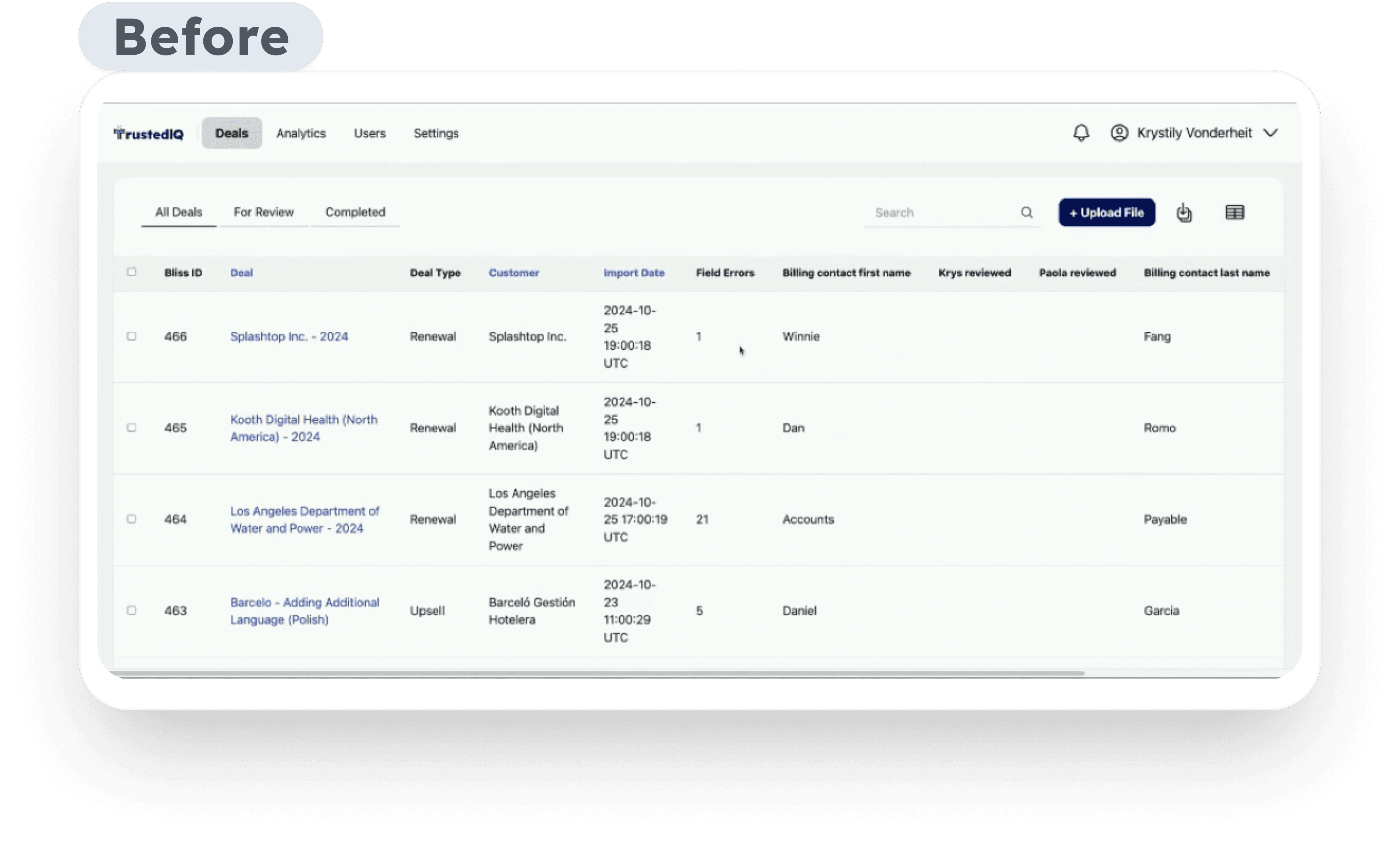
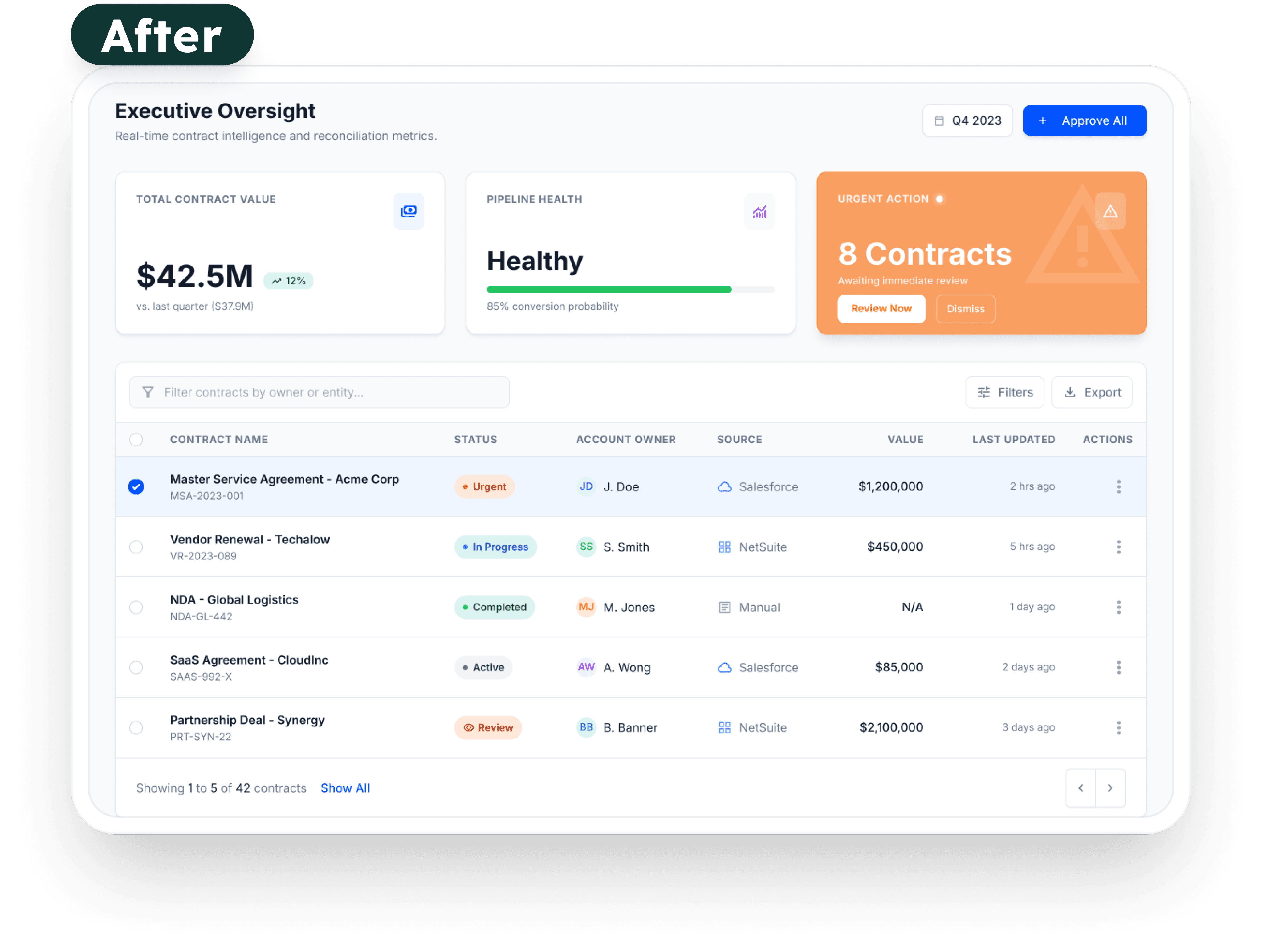
The original dashboard forced manual scanning just to gauge basic work status. Every deal carried the same visual weight, masking high impact items. Critical contract values and financial risks were buried inside records, hidden from leadership.
I introduced hero metric cards for Total Contract Value ($42.5M) and Pipeline Health to give executives an instant pulse on the business. A high contrast "Urgent Action" card tells users exactly how many contracts need immediate review. I stripped away administrative clutter and replaced it with high signal data: status tags (Urgent, Review, Active), data source labels, and contract value. Executives no longer hunt for discrepancies; they open the dashboard and immediately see a prioritized list of revenue risks.
AI INTEGRATION STRATEGY
AI as a Business Partner: From Passive Tool to Active Co-Pilot
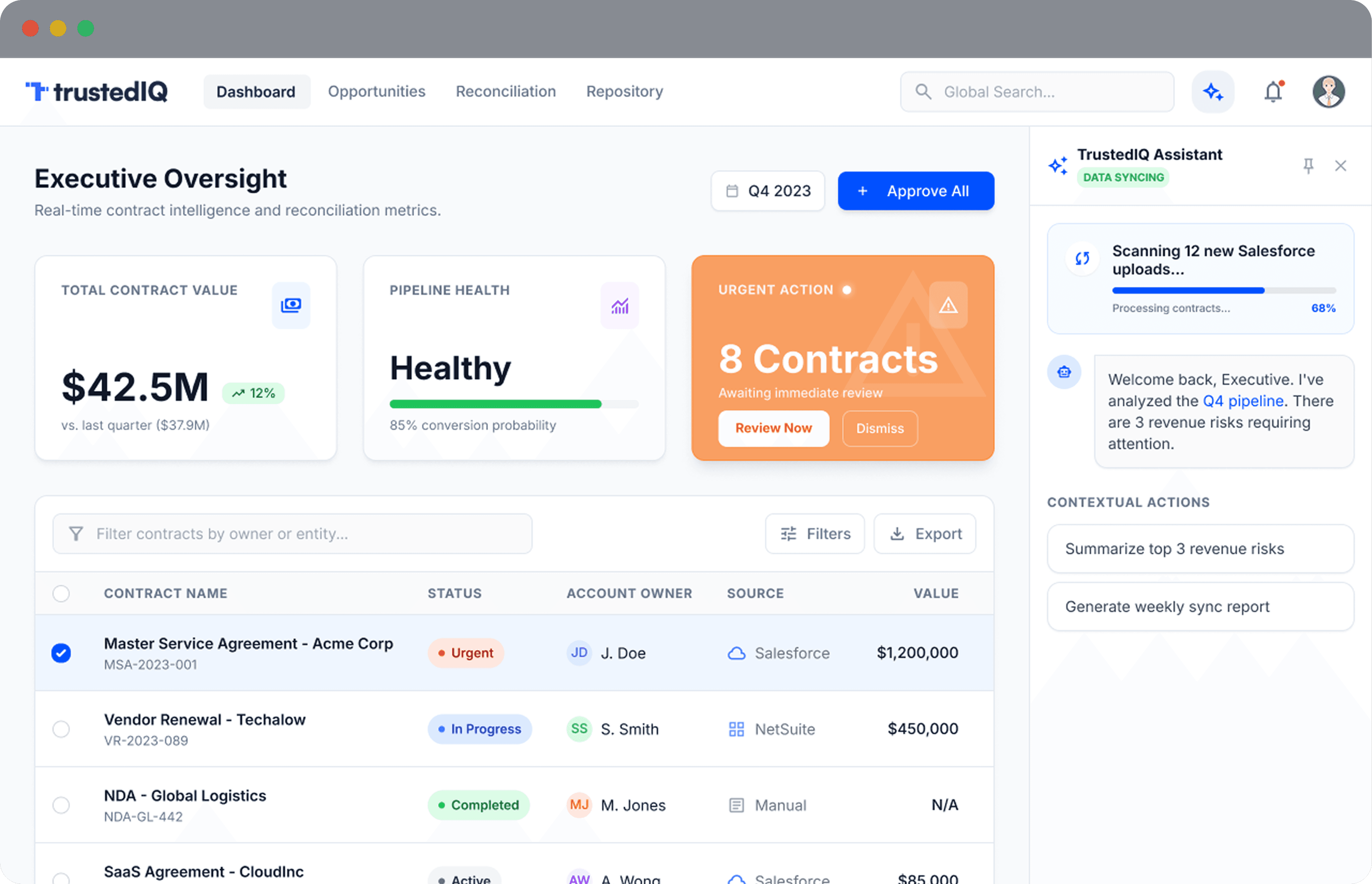
The AI integration followed three principles. First, contextual intelligence: the sidebar reads the active screen state to offer actions relevant to the specific data being viewed. Second, proactive processing: the system runs in the background scanning uploads and surfaces results only when actionable. Third, single click resolution: complex workflows like risk summarization are collapsed into contextual action buttons.
Core Experience Overhaul
Scaling Efficiency with Batch Auto-Resolve
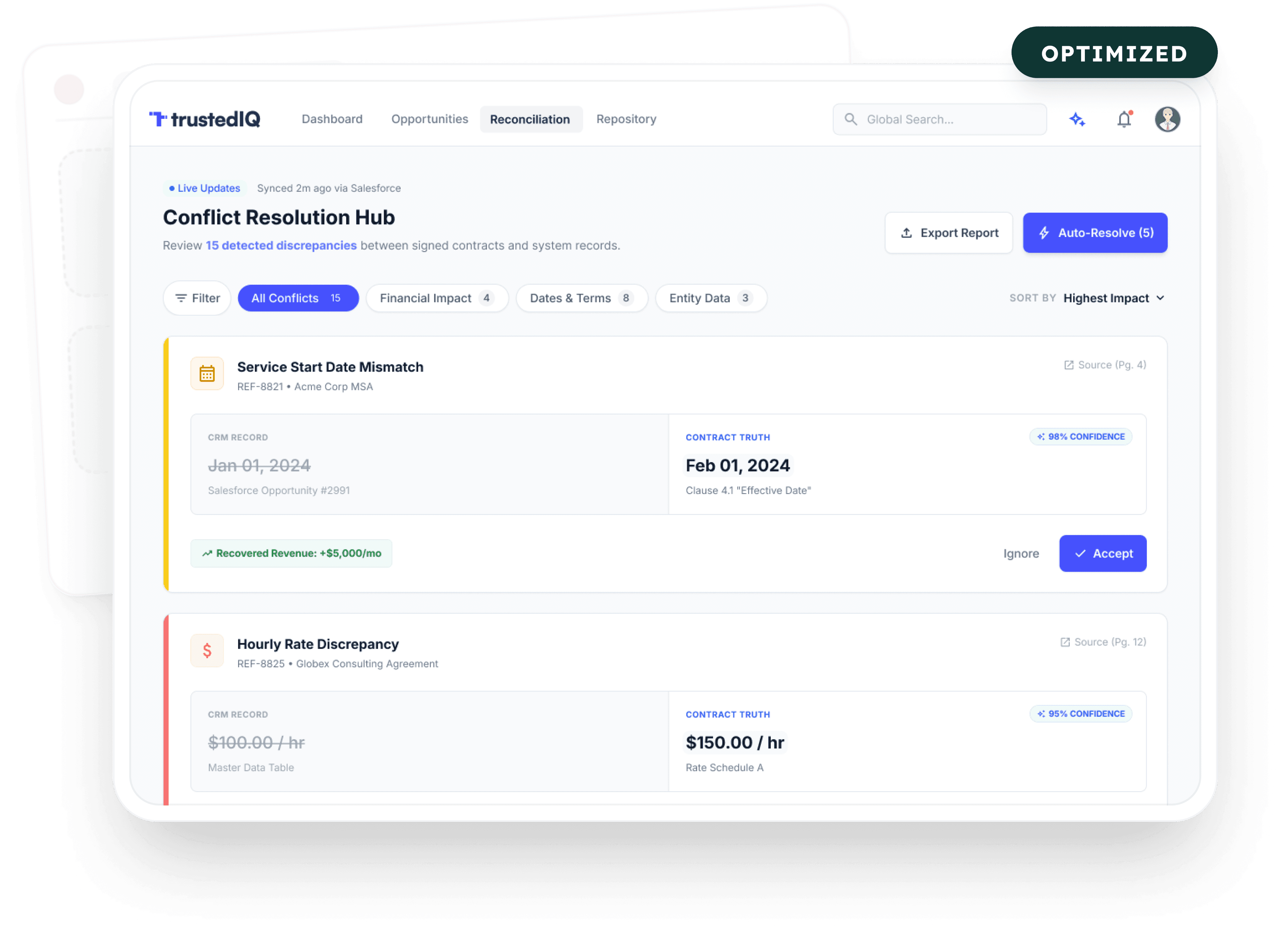
When a user has 15+ detected discrepancies, they need a way to triage based on financial gravity. I implemented filters for financial impact, dates and terms, and entity data so teams can prioritize the bottom line first. For high confidence mismatches, I added an auto resolve button that handles batch updates instantly. Every conflict card clearly displays the stakes, such as "+$5,000/mo Recovered Revenue" or "$12,500 Underbilling Risk.
cohesive visual language
Design Systems
The Compound Effect
3.5x
Weekly active users grew 3.5x, the compound result of faster reconciliation, smarter prioritization, and an interface that executives actually wanted to use.
A Shift In Logic
Reflections
Data Density Isn't Data Value
The original dashboard had more information than the redesign. It was also less useful. In data heavy products, the design challenge isn't showing everything. It's deciding what deserves attention and what deserves to disappear. Curation is the product.
Finance Teams Think in Risk, Not Records
I initially organized the interface around data accuracy. Users didn't care about clean data for its own sake. They cared about what dirty data was costing them. Reframing the product around financial risk instead of data hygiene made every design decision clearer.
Nobody Trusts a Blackbox
The platform had AI capabilities from day one, but adoption was low because users didn't understand what the AI was doing or why they should trust it. Making the AI's reasoning visible, showing why it flagged a specific mismatch and what pattern it detected, drove a 72% increase in AI adoption. Features don't matter if users don't trust them.

© 2026. All rights reserved.